Hello, Sternbild citizens, it’s Aki again! This time I have for you an interview with Satou Keiichi, the kantoku-man director of T&B. You can find it in the august issue of Animage.
Disclaimer: not a professional translator, doing this for fun, etc. Standard fantranslation rules apply.
Q: We’re halfway through the show. Comments?
Satou Keiichi: At first, when we were planning everything – even though Tiger&Bunny is a hero show – we wanted to add dialogue that’d make the audience laugh. That’s because we wanted to create a comedy without gags that would bring the action down. For that purpose, we needed realistic characters with whom you can easily sympathize. There are different kinds of “real”, though, but what I wanted to do is present characters that have flawed personalities; when you see them, you think “people like that exist, too”. That’s also why I wanted to add elements that are normally not present in hero shows, like people eating bread or clipping their nails, simple scenes from our everyday lives.
Q: There really are many things the audience can sympathize with in the show.
Satou: Thank you very much. At first, through the advertisements for the sponsors, we showed the original concept of this show – that is, the drama with heroes in suits living in a harsh world. But then, the producer suggested we should add elements that working people, like salarymen or OLs, would enjoy – and so, the show took the form it has now. When I first got involved in the production, it was the time of the so-called “Lehman shock”, and then we have experienced the powerful earthquake. So, above all else, I wanted to introduce characters that would encourage the people who watch the show, give them that necessary push. Kotetsu is like a sports player who challenges the overseas, never giving up; the advertisements in the show remind us of hard technological competition between corporations… Images like that are crammed into the show. Of course, since this is a hero show, we needed some cool things as well, but instead of presenting them stylishly through action or design, we wanted to show them through the characters themselves. For example, Kotetsu’s smart, mature thinking makes him the center of human relationships in the show.
Q: Kotetsu’s personality comes out even more thanks to Barnaby’s presence, doesn’t it.
Satou: Thanks to the differences between them, their individual personalities are highlighted. Well, Barnaby, however you want to put it, is a kind of an oddball (laughs). He presents himself as a very stoic person. But in the modern society, there are situations when senpai says “let’s go out for a drink!”, and their kouhai turns them down coldly (laughs). Because we inserted lifelike situations like that, people can connect with the characters more easily, their actions become more clear to them.
Q:Time to wrap up this interview. Could you tell us what awaits us in the future?
Satou: There is a 10-month time skip between episodes 13 and 14. There are people riding on the wave of their popularity, as well as people you could describe as a bit depressed. I think it’s something the audience can sympathize with, too. Also, to generalize a bit, the first half of the show focused on this feeling of distance between people, on human relationships, how they become close and how they fall apart. In episode 13, for the first time ever, Barnaby called Kotetsu “Kotetsu-san”, so you could feel that their relationship got truly stronger. However, the thing with relationships is, you never know what might happen the next minute. How will their relationship change between the two parts of the show, and how will it evolve? Because this is a show that takes the distance between the characters very seriously, you should focus on that. I’ll be happy if you all enjoy it.
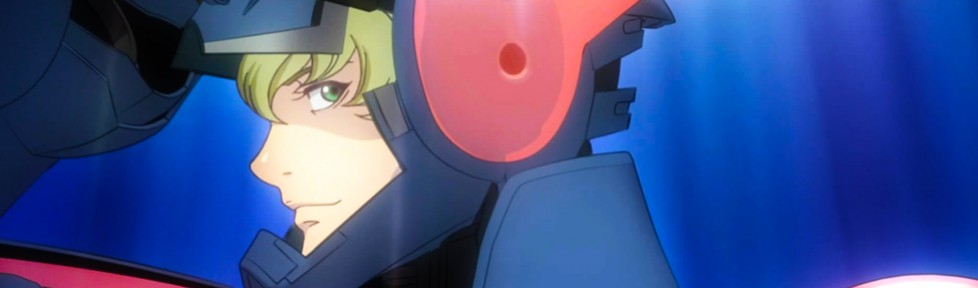
 This news snippet from Nikkei Marketing Journal posted in a Japanese blog hints very strongly that a second season might come true. It’s still in planning stage but considering the current popularity of the show, I’ll be surprised if they don’t get it greenlit. The blog entry also mentions that there’s an event planned that’ll be tieing in with the airing of the final episode on September 17th.
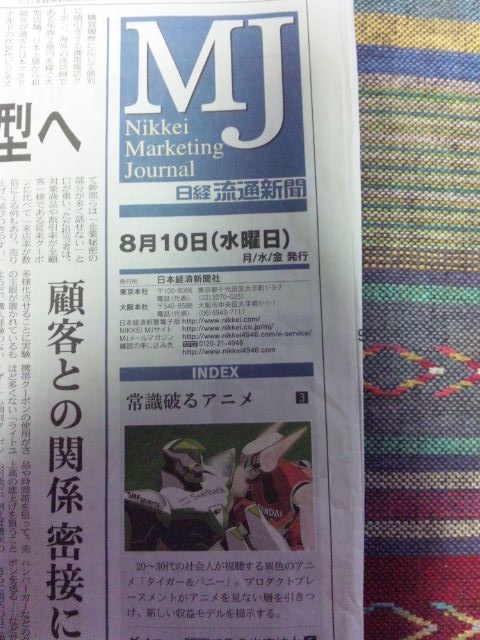 I was tracking down the article and found that Tiger & Bunny is actually one of today’s Nikkei Marketing Journal’s main news. In short, the headline on the site reads “Bill-board Heroes Break Down the Common Rules of Anime” and the blurb text seems very excited about the new business model Tiger & Bunny has presented.
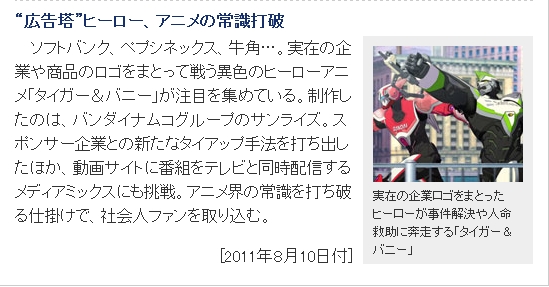 I find this pretty funny, since one of the reasons they had to get all those sponsors was to even get the project off the ground. It’s innovative, sure, but it’s not like they had much choice. As for second season, I’ll get excited if Satou will still be directing and Nishida writing it. Until then I’m gonna just wait and see.

 This is Sternbild